
Context
Grafton did not have a recognised backbone organisation or a recognised need for one. When we asked leaders where they would go for support to make a collective impact, the most common answer by default, not by design, was council. Topic-specific networks existed but were seen to operate in silos. Leaders working on social outcomes in the same community were not always familiar with each other’s work, and there was no forum for strategic, cross-sector conversation beyond operational concerns or case management.
The Readiness Index baseline confirmed that structure and leadership for collaboration scored low (2.5 out of 5) and idea development pathways scored 2.0. When someone had an idea for change, there was no clear pathway to turn it into action.
Feedback from the Readiness Index reflected that:
- Groups “achieve great outcomes but those outside the silo are not informed”,
- there was “a lack of backbone support for collaboration” where “leadership, coordination, and admin behind those efforts are almost always unfunded”,
- “While there is shared understanding of issues and sufficient trust to enable collaboration, there is not the level of structure and leadership allocated to these collaborations to fully realise their potential”
- “There is not a clear understanding of the value of certain collaborations”
Particularly notable was a comment in the Readiness Index survey in May 2025 that “the Chamber of Commerce appears to not have a concept of social enterprise; it might be an opportunity to establish a social enterprise ‘chamber’” several months before the concept was raised separately after the Social Impact in the Regions conference.
What we did
Our work focused on relationships: one-on-one conversations with leaders across sectors, connecting people who were working on overlapping challenges without knowing it, and creating space for strategic thinking outside the demands of day-to-day operations. Following the Social Impact in the Regions conference, the leaders we had been working with shared comments in individual conversations about the benefit of working closer with others.
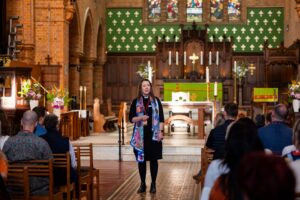
Over coffee in late 2025, Leon Ankersmit – CEO of Caringa, a 90-year-old disability services organisation – reflected on the connection with others who thought the same way and the space to step out of operations and think strategically. He said something close to: “We need a place to have these conversations. We need something like a Chamber of Commerce – almost like a Chamber of Purpose.”
The name stuck. We discussed the idea, agreed to convene a meeting in the new year, and held the first gathering in late January 2026. A second meeting followed in February, a third in March. New people continued to attend. A soft launch is planned for May, with a formal launch in July.
What’s shifted
The Chamber of Purpose is a clear outcome of strengthened readiness conditions producing a community-owned structure.
- Clarity and understanding improved as leaders gained visibility of each other’s work and developed a shared language for strategic collaboration.
- Connection and connectivity shifted as the engagement process linked people across sectors who had not previously interacted despite living and working in the same community.
- The group is forming due to the capability of the individuals involved, while continuing to develop leadership capability in the collective. There is an open question as to the capacity of the volunteer-run group as it looks for support models.
- Collaboration for purpose moved from informal goodwill to a named, meeting, growing structure with its own identity and orientation toward shared community outcomes rather than individual organisational interests.
- The group is considering it role in advocacy for social impact work in the region.
If we had walked into Grafton on day one and proposed a Chamber of Purpose, the response would have been incomprehension or resistance. It emerged as the conditions were developed.
What’s forming (impact)
The collective has potential for long-term impact for individuals, the organisations they represent, and the community overall.
- Economic: The Chamber creates a pathway for coordinated investment attraction and resource sharing across the social impact sector. If it matures, it could function as a channel through which funders and investors engage with Grafton’s social economy, reducing fragmentation.
- Social: The Chamber provides cross-sector relational infrastructure that did not previously exist. In a community where “relationships are the currency we use,” as one respondent wrote, a structure that sustains strategic relationships beyond individual goodwill addresses a gap that informal networks could not fill.
- Institutional: The emergence of a community-initiated governance structure is itself significant. Rather than having a backbone organisation appointed, funded, or imported, the community is arriving at its own coordinating structure at its own pace and in its own form. Whether it endures and takes on a genuine backbone function remains to be seen, but the fact that it exists at all is a direct consequence of the readiness work.
- Environmental and infrastructure impacts are not expected from this initiative.