
Over two days in July, we ran six conversations with regional Australia, one for each of the 2026 National Regional Challenges. People joined from chambers of commerce, councils, schools, neighbourhood centres, community radio, farms and not-for-profits, from Stanthorpe and the Granite Belt out to Goondiwindi, Tenterfield, the Clarence, Chinchilla, Singleton, Tasmania and South Australia. Different towns, different pressures, and common ground.
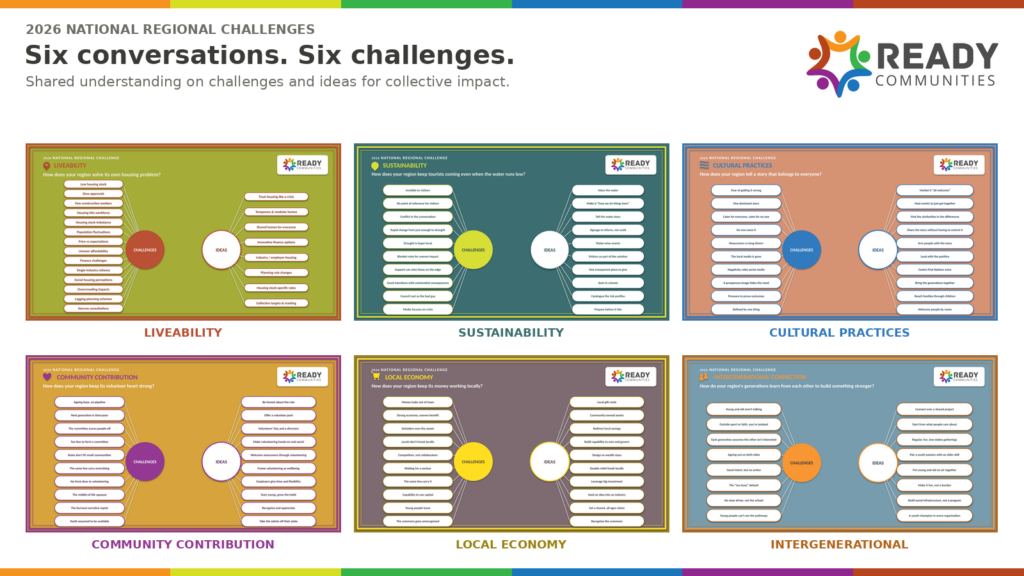
The National Regional Challenges focus collective attention on the systemic conditions no single organisation, policy, or intervention can shift alone. The six challenges launched in 2026 are drawn from our two-year flagship program in Stanthorpe, Queensland, and each is built to grow national and regional readiness: clearer sight of who’s involved, stronger connections between change-makers, more capability to act, real collaboration for a shared purpose, and advocacy for what works.
The Challenge Engine runs in three stages:
- Inform — gather national case studies, mapping, and virtual sessions, January to September.
- Commit — set shared targets at the Social Impact in the Regions conference in September.
- Act — a cohort of regions run initiatives and report results against those targets.
Each conversation is written up in full, with the challenges named, the ideas surfaced, and the words of the people in the room. Here is the shared understanding across the six challenges.
Liveability
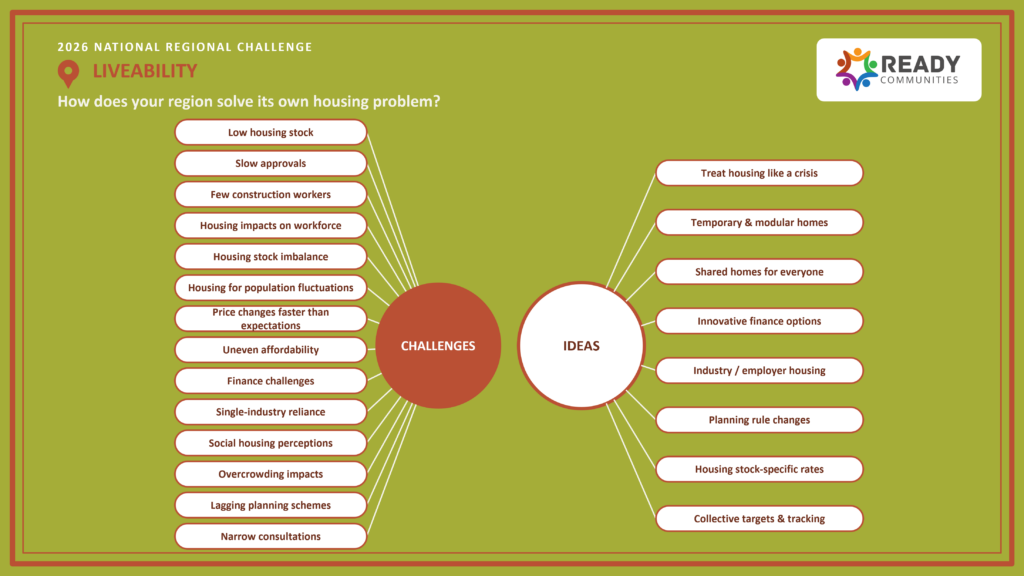
How does your region solve its own housing problem?
Housing raised systemic challenges: supply at breaking point, the trades-and-housing squeeze, and short-stay accommodation crowding out long-term homes.
Sustainability
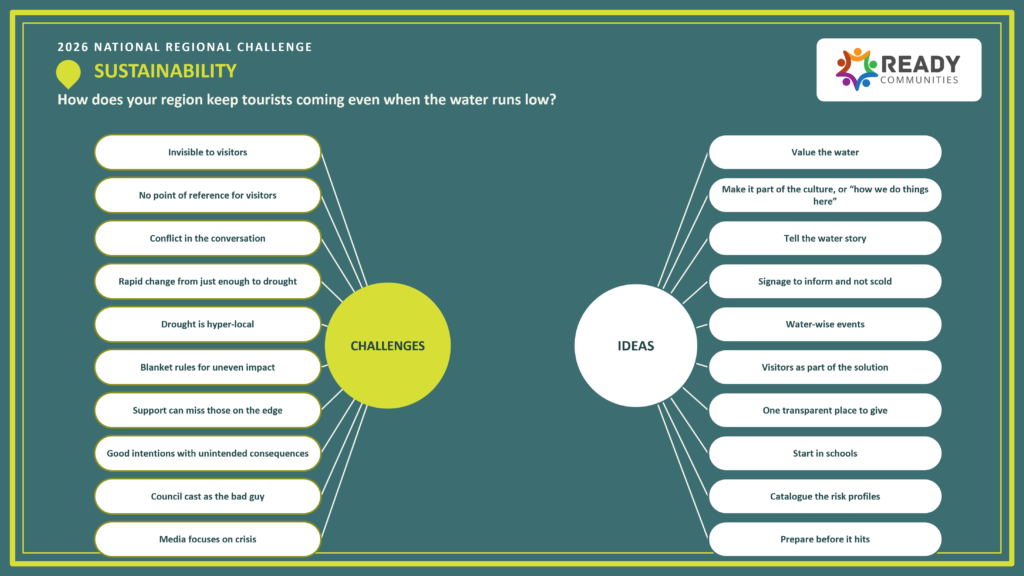
How does your region keep tourists coming even when the water runs low?
At the nexus of drought and tourism, the problem is that scarcity can be invisible to visitors and hard to raise without conflict. The response is about valuing water, telling its story, and making it about “how things are done around here”.
Cultural Practices
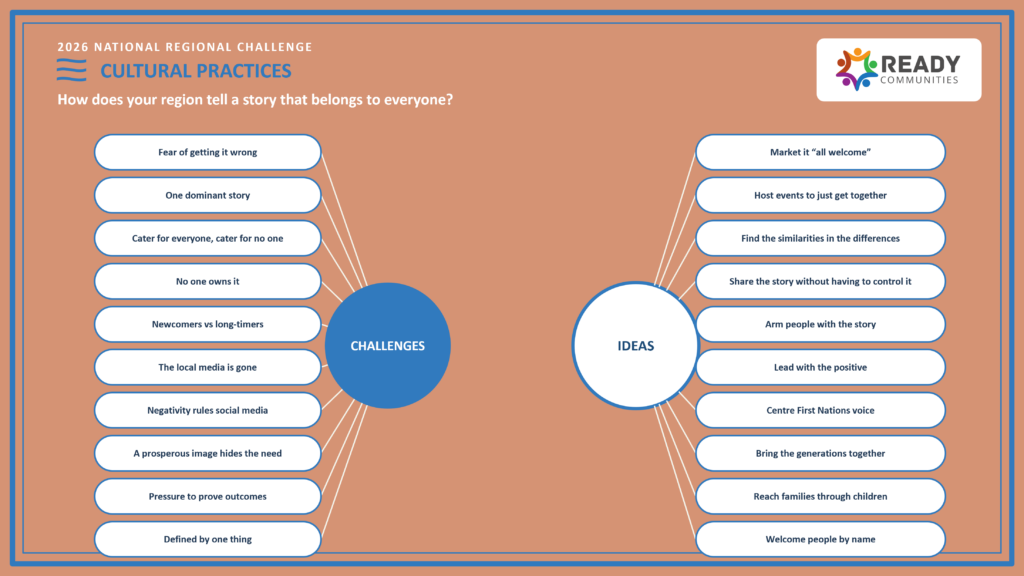
How does your region tell a story that belongs to everyone?
Every region tells its story through brochures, media, festivals, and Facebook groups. These stories can share a view that may not include everyone, in which one voice is the loudest or one heritage is best known. The local media that used to help carry these stories are mostly gone. The question is whether that story that remains includes everyone it represents.
Community Contribution
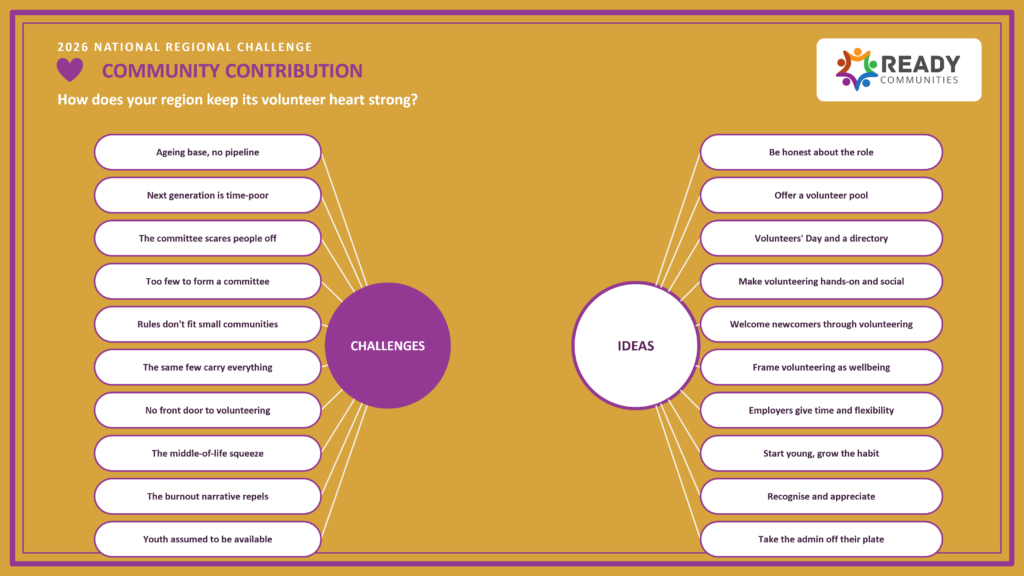
How does your region keep its volunteer heart strong?
Volunteers are essential in a regional town. Volunteers run the radio station, the neighbourhood centre, the show, the Meals on Wheels, and the men’s shed. Volunteering is also facing increased pressures from shrinking and aging populations, families under greater financial pressure, and the word “volunteer” carrying unhelpful connotations of overwork and burnout. The benefits of volunteering for both individuals and their communities go beyond stories about getting more hours from the same people.
Local Economy
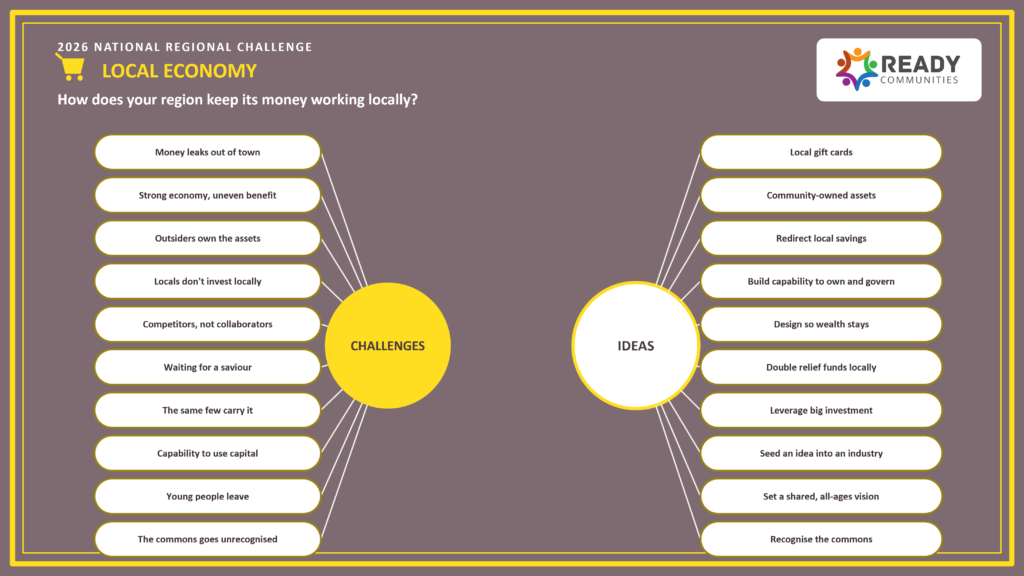
How does your region keep its money working locally?
A dollar spent in a regional town can circulate through a dozen local hands, or it can leave in a single tap when it goes to a national chain, an online cart, or an investment outside the region. Keeping money working locally is about who owns the assets, who gets to invest, and whether the value a place creates stays in the place that made it. This conversation drew in community-capital researchers, gift-card and equity-crowdfunding founders, council economic developers, and people building new local industries.
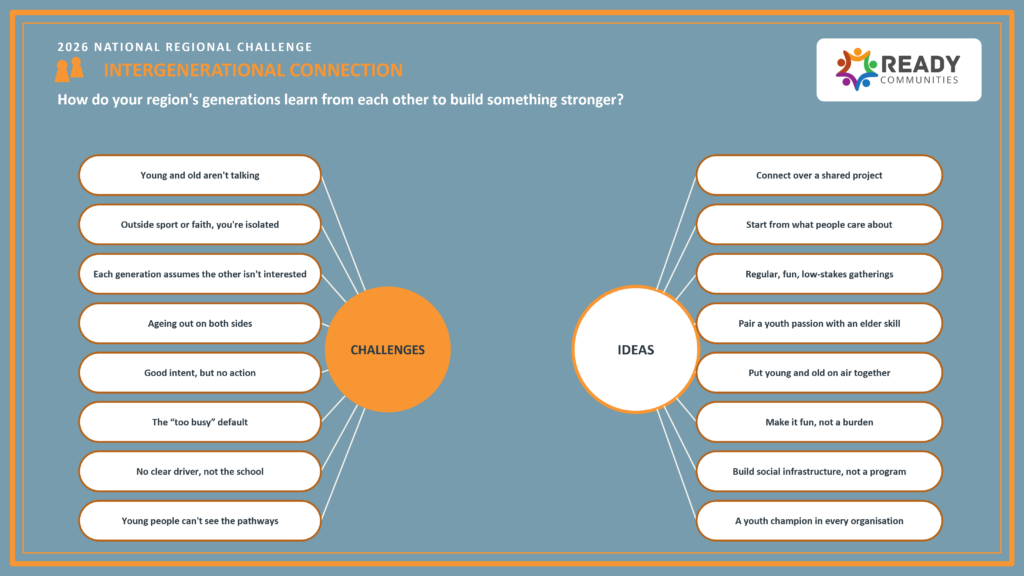
Intergenerational Connection
How do your region’s generations learn from each other to build something stronger?
The word “youth” is deliberately omitted from the challenge title to emphasise the connection between generations. This session was different from the others: a smaller, working conversation, more of a planning session for Stanthorpe’s upcoming youth “hackathon” than a broad national panel. It leaned less on cataloguing pressures and more on how to get the generations into the same room.
What’s next
This is the Inform stage of the Challenge Engine, and it is ongoing. If any of these challenges are your region’s, there are three ways to take part:
- Read the write-ups,
- Submit a case study for collective learning and the possibility of a sponsored ticket to the Social Impact in the Regions conference, and
- Join us at the Social Impact in the Regions conference in September, where these insights become shared targets.
Case studies can be submitted through the National Challenge website. We would like to hear how your region is meeting these challenges.